
Welcome to our newsletter, where we provide insightful legal updates and expert advice on French law, tailored to meet the needs of international clients navigating the complexities of the French legal system
Since the Law of October 24, 2025 (No. 2025-989), the mandatory professional interview previously held every two years has been renamed the Career Development Interview (entretien de parcours professionnel).
The topics covered and the timing of this interview has been updated, and new interviews have been introduced at key stages of an employee’s career, for the middle and end of a career.
- New frequency: 1 – 4 – 8
Employers must now inform new hired employees that they will benefit from a career development interview during the first year after being hired.
After the first interview, employers must organise an interview every four years, instead of every two years as before.
This change also affects the employee’s career review, which aims to verify that the employer has fulfilled its obligations regarding interviews and access to training. Previously conducted every six years, this review must now take place every eight years.
- Updated content
Regarding the content of the career development interview, previous legislation only stipulated that the interview should focus on career development, particularly concerning qualifications and employment opportunities.
The content of the career development interview is now explicitly defined, giving employers clear guidance on the topics to be discussed:
- Skills and Qualifications: Assessment of current skills and consideration of how they may evolve in accordance with the company’s transformations.
- Career Path: Evaluation of the employee’s current situation in relation to evolving roles and opportunities within the organisation.
- Training Needs: Identification of training necessary for current responsibilities, anticipated future roles, or personal professional projects.
- Career Aspirations: Discussion of professional growth, potential internal or external career changes, career transition projects, skills assessments, or recognition of prior experience (VAE).
- Training Funds: Activation and use of the Personal Training Account (CPF), potential employer funding, and professional development counseling (CEP).
In companies with fewer than 300 employees, the employee may, in preparation for this meeting, benefit from a career development counselling (conseil en évolution professionnelle).
- Specific Career Interviews
Another change in the law is that career development interviews must follow a different format at two specific points in an employee’s career:
Mid-Career Interview: As part of the career development process, employers must organize a professional career interview within two months after the “mid-career medical visit”, which takes place during the year of the 45th anniversary. During this interview, topics such as adapting the workstation, preventing work-related health problems, and career mobility or change should be discussed.
Pre-60th Birthday Interview: Also as part of the career development process, an interview must take place within the two years before the employee’s 60th birthday. The discussion should cover job retention conditions and possible end-of-career arrangements, for example, part-time work or gradual retirement (retraite progressive).
- Implementation and Transition Rules
In its "Q&A" published on February 12, 2026, the French Administration provided the following clarifications:
- The transition from the previous schedule (every 2 years) to the new schedule (every 4 years) will start from the date of the last interview. This new schedule has been applicable since October 26, 2025.
Example :

- In case the CBA specifies a different cycle duration than 4 years, the new changes will take effect from October 1, 2026.
- Collective agreements providing for a frequency of less than 4 years are not subject to the renegotiation requirement and may remain in force after October 1, 2026.
EU Directive n° 2023/970 of 10 May 2023 on pay transparency must be transposed into French law by 7 June 2026.
The French Ministry of Labour has acknowledged that the deadline will not be met and intends to present a bill before the summer and have it voted on by the start of the fall semester/end of the year.
However, this latter has held consultation rounds with social partners, in summer 2025 and on 15 January 2026, presenting "arbitrations" on the bill's content on the four following subjects: gender equality index, pay transparency in recruitment, employee’s right to information and sanctions for non-compliance.
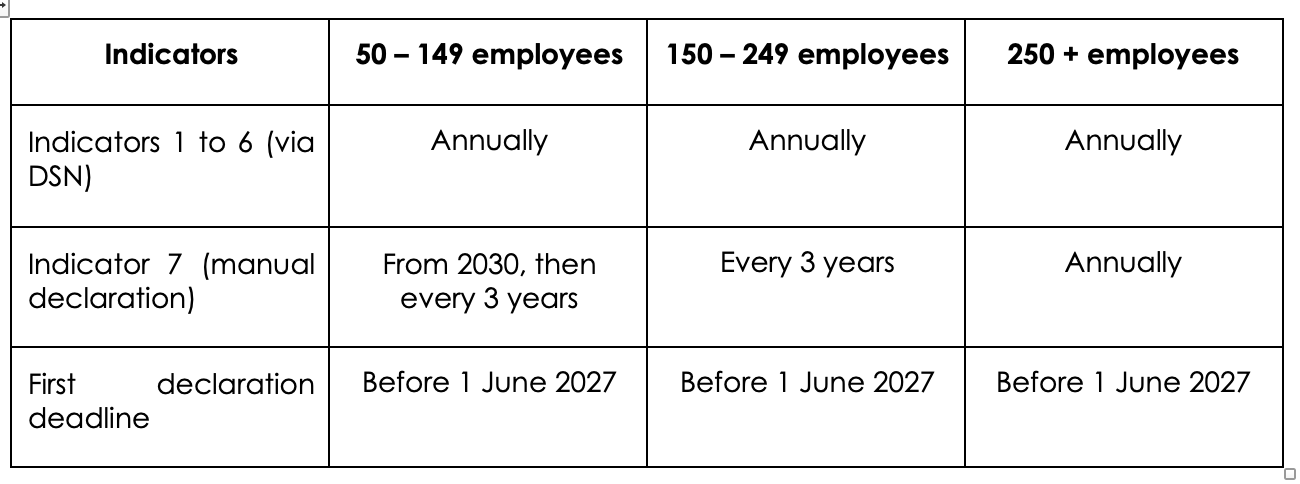
- Gender equality index - draft schedule – who would declare what and when?
- Pay transparency in recruitment
In a document shared with social partners on 20 May 2025, the Ministry of Labour set out its intention to introduce several new requirements into French law that will directly affect how job offers are written and how interviews are conducted.
Employers would be prohibited from publishing job offers that do not include an initial salary range, as well as information on the applicable collective agreement provisions for the role in question. Employers would also be banned from asking candidates about their previous salary history.
At the 15 January 2026 meeting, the Ministry clarified that the range of salary included in job offers would not be regulated by legislation. Employers will therefore retain some flexibility.
Additionally, where no formal job offer exists, employers would be required to communicate salary information to candidates in writing, either before or during the job interview.
- Employees’ right to information
The directive also establishes a new "right to information" for employees regarding pay practices within their organisation. The Ministry of Labour's document of 7 June 2025 sets out how this right would be implemented in French law, creating a series of binding obligations for employers.
Employers would be required to inform all employees in writing, on an annual basis, of their right to obtain information on remuneration, specifically their individual pay and the average pay levels broken down by gender for workers performing work of equal value.
Upon request, employers would then have to provide this information within a reasonable timeframe not exceeding two months. Where an employee chooses to route their request through a staff representative or the Défenseur des droits, the employer would equally have two months to transmit the relevant information. Employers would also be required to provide clarification on the methodology used to determine pay where relevant.
The transposition bill would also introduce into the Labour Code an explicit prohibition on any contractual clause preventing workers from disclosing information about their own remuneration.
During the 15 January 2026 meeting, the Ministry further specified that the new communication obligation would apply from the moment a company has defined its categorization, i.e., its pay comparison perimeter, whether by company agreement, branch agreement, or unilateral decision — and no later than 1 June 2027.
- Sanctions for non-compliance
The Ministry of Labour's document shared at the 15 January 2026 meeting distinguishes between two categories of administrative sanctions, both of which would be pronounced by the Dreets (French administration).
- For breaches relating to the gender equality index: the penalty would be an administrative fine of up to 1% of total payroll.
- For breaches of Articles 5 to 8 of the directive (covering failures such as not responding to an employee's information request, failing to inform a candidate of their initial salary, making pay information inaccessible to workers with disabilities, requesting a candidate's salary history, or failing to make pay criteria available) : a flat-rate administrative fine of €450 per breach would apply.
In both categories, the sanction would be doubled if a breach of the same type has already been recorded within the preceding five years.
***
Our firm remains at your disposal to provide support on these subjects.